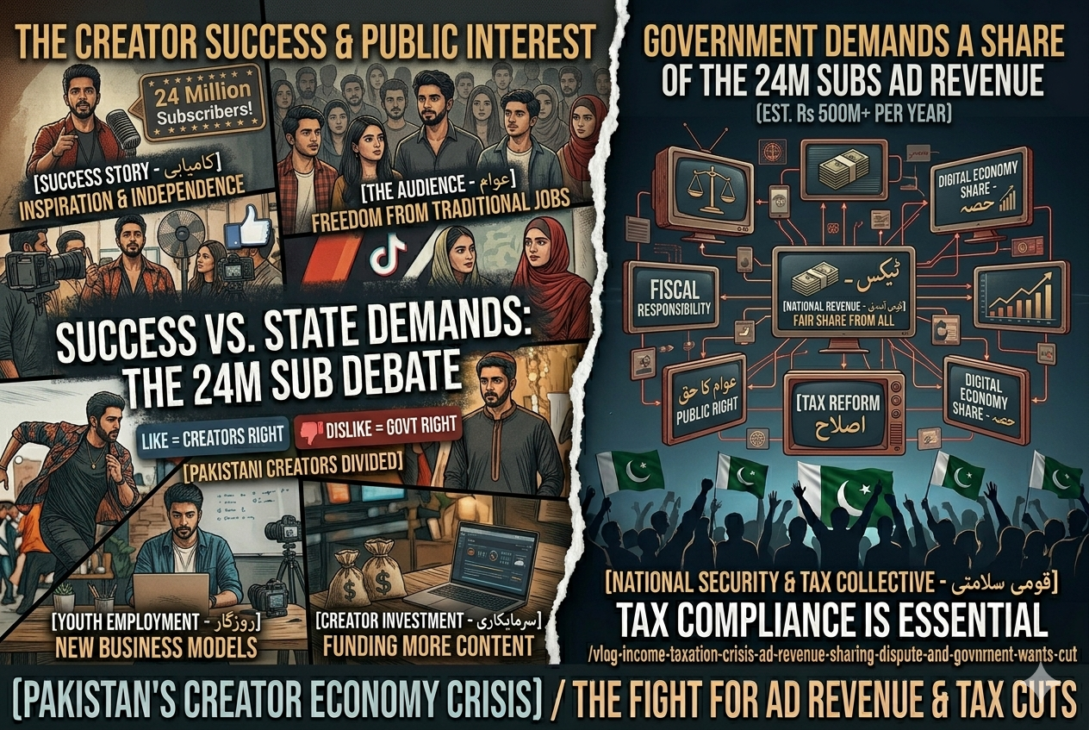
LAHORE — Brothers Vlog have 24 million YouTube subscribers. Twenty-four million. To put that in context, that is more subscribers than most Pakistani television channels have ever accumulated viewers across their entire broadcast histories. Brothers Vlog — the Pakistani YouTube channel known for food challenges, family comedy, and high-energy vlogs — is not a hobby. It is a multi-million rupee media operation. And Pakistan’s Federal Board of Revenue has finally, unmistakably, figured that out.
For years, Pakistan’s booming creator economy — built by channels like Brothers Vlog, by TikTok stars like Jannat Mirza and Kanwal Aftab, by rap influencers like SidMrRapper — operated in a comfortable grey zone. Brand deals were settled in cash. YouTube AdSense arrived in dollar transfers that looked to bank algorithms like foreign remittances. TikTok gifts were nearly impossible to trace. The FBR was largely nowhere to be seen. That era is over.
“Social media influencers generating income through brand deals, platform monetisation, and gifting revenue are required to file income tax returns like any other professional. Full compliance is expected.” — FBR spokesperson, April 2026
Brothers Vlog: The Scale of Pakistan’s Creator Economy
Brothers Vlog are the most prominent example of just how large Pakistan’s creator economy has become. With 24 million YouTube subscribers and content that generates tens of millions of views per video, Brothers Vlog operate at a commercial scale that rivals — and in some metrics exceeds — Pakistan’s mainstream television production houses. Their food challenge videos, family vlogs, and comedic content have built a loyal audience that spans Pakistan, the Gulf diaspora, the UK Pakistani community, and increasingly, non-Pakistani audiences attracted by their format and energy.
Brothers Vlog represent the upper tier of a creator economy that now includes creators across every conceivable niche — comedy, gaming, fashion, cooking, travel, religious content, political commentary, and the lifestyle and dance content that has made names like Jannat Mirza, Kanwal Aftab, and Sehar Hayat household names across Pakistan.
Jannat Mirza — Pakistan’s most followed TikToker — generates brand deal income at rates that industry insiders estimate in the millions of rupees per placement. Kanwal Aftab has built a formal business empire around her influencer status, with product lines, modelling work, and sponsored content that her accountants handle through a proper corporate structure. At the other end of the scale, creators with 100,000 to 500,000 followers — the mid-tier that includes thousands of Pakistani TikTokers and YouTubers — are earning meaningful income from brand deals, affiliate marketing, and platform monetisation that they have, in many cases, never declared.
What the FBR Is Actually Doing
The FBR’s approach to the creator economy is operating on two tracks. The first is data matching — cross-referencing bank account inflows from YouTube, TikTok, and Instagram against filed tax returns to identify creators who are earning above taxable thresholds without declaring. The second track involves the FBR approaching major influencer marketing agencies and large brands, requesting disclosure of payments made to creators. If Brothers Vlog received Rs5 million from a beverage brand for a sponsored video, and that brand is filing that expense, the FBR now has the data to check whether Brothers Vlog declared the income.
Creators who have been earning without filing are being given a compliance window. Those who continue to evade after notification face surcharges, penalties, and in serious cases, asset freezes or criminal referral under Pakistan’s income tax ordinance.
How Top Creators Are Responding
The response from Pakistan’s creator community divides neatly into three camps.
The first camp — which includes professionally managed operations like Brothers Vlog and Kanwal Aftab’s brand — is largely compliant or moving quickly toward compliance. Kanwal Aftab, whose business includes product lines across multiple market sectors alongside her influencer income, has the corporate infrastructure to absorb the FBR’s new attention without serious disruption. For Brothers Vlog, operating at 24 million subscribers, the income is substantial enough that professional tax management has presumably been a feature of their operation for some time.
The second camp — mid-tier creators earning Rs50,000 to Rs500,000 per month from a mix of brand deals and platform income — is the most anxious. Many of these creators, including thousands of TikTokers in the style of Sehar Hayat or Daniyal Sawati, were simply unaware that their incomes crossed taxable thresholds or that foreign platform payments were subject to Pakistani tax. Tax advisers with digital economy expertise report a dramatic spike in consultations from this segment since the FBR announcement.
The third camp — small creators, nano-influencers, and TikTok Live gifting-focused creators like those criticised by Daniyal Sawati for their “BayHayyayi” content — is largely flying below the FBR’s current radar. Their incomes, while meaningful to them personally, are below the thresholds that the FBR’s limited administrative capacity allows it to pursue systematically.
The Bigger Picture: Pakistan’s Creator Economy Is Worth Taxing
The FBR’s move is fundamentally correct, even if the implementation will be imperfect. Brothers Vlog earn at scales that are objectively comparable to profitable small businesses. Jannat Mirza’s brand deal income would make her one of the higher-earning individuals in Lahore’s professional class. Kanwal Aftab’s combined influencer and business income would comfortably qualify her as a high-net-worth individual under any reasonable tax framework. The idea that any of this income should be exempt from taxation because it flows from a smartphone rather than an office is not defensible.
What Pakistan’s creator economy needs from the FBR is not just enforcement, but fair and purpose-built rules that reflect how digital income actually works. The mix of platform monetisation, brand deals, live gifting, affiliate commissions, and merchandise revenue that creators like Brothers Vlog, Jannat Mirza, and SidMrRapper earn does not fit neatly into the tax categories designed for salaried employees or traditional businesses. The FBR will need to update its frameworks — not just its enforcement — if it wants creators to comply willingly rather than hiding in the grey zone.
The creator economy is real. Brothers Vlog’s 24 million subscribers are real. The money is real. It is time Pakistan’s tax system caught up.