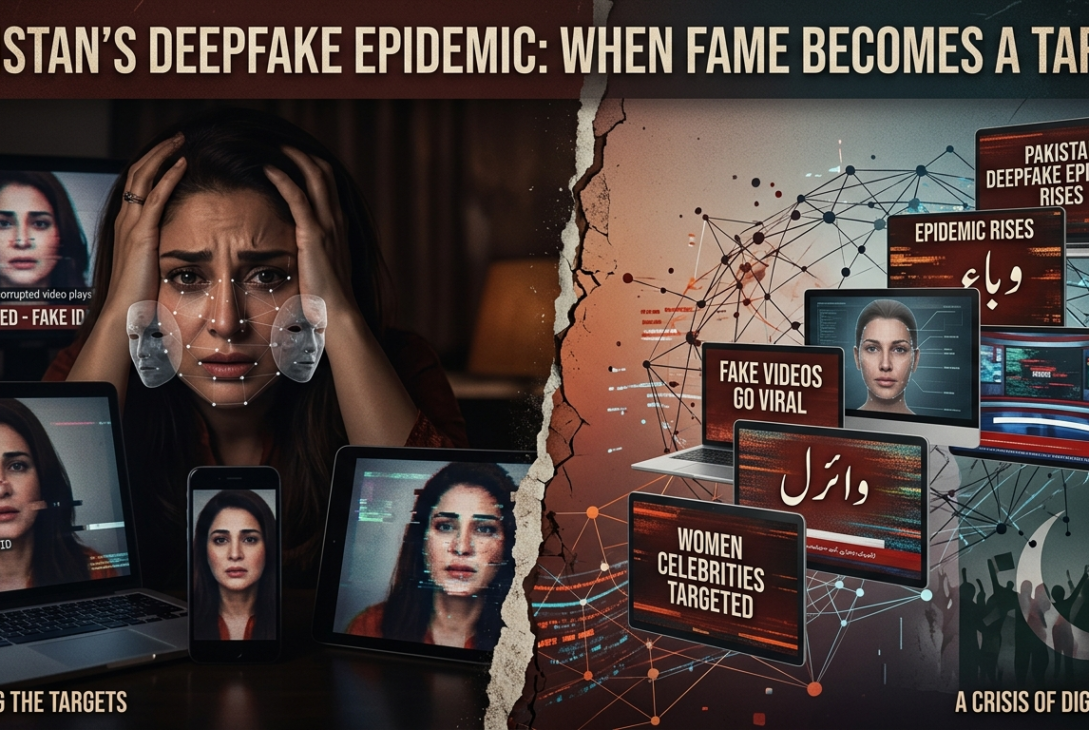
LAHORE — She had millions of followers, brand deals, and a career built post by post over years of consistent, creative work. Then one morning she woke up to find an explicit video — claiming to show her — circulating across WhatsApp groups, X timelines, and TikTok comment sections. She had never filmed it. She had never consented to it. It did not exist until someone, with a laptop and a grudge, made it exist.
This is the story of not one Pakistani influencer but many. In the past eighteen months, a pattern so consistent it has become a crisis has gripped Pakistan’s social media landscape: female creators — famous, followed, and overwhelmingly young — are being targeted by deepfake and allegedly leaked intimate videos, distributed by ex-partners, online trolls, or anonymous actors with malicious intent. The names include Samiya Hijab, Kanwal Aftab, Minahil Malik, Imsha Rehman, Maryam Faisal, Alina Amir, and Mathira Khan. The damage — reputational, psychological, professional — is real, regardless of whether the videos are real.
“I completely deny this video and have nothing to do with it. My character is being deliberately targeted to damage my reputation on social media. This content has been made viral by my ex-boyfriend due to personal enmity and revenge.” — Samiya Hijab, public statement
The Anatomy of a Deepfake Attack
The mechanics of these incidents follow a disturbingly predictable script. A video surfaces — usually first on WhatsApp, then spreading to X and TikTok — showing a woman who resembles a known influencer in a compromising situation. The video is grainy enough to cloud verification but clear enough to spread. Hashtags ignite. Followers divide into camps: those demanding accountability and those defending the creator. Within hours, the video has been seen by hundreds of thousands.
Pakistani TikTok star Samiya Hijab publicly denied involvement in a video circulating on social media, calling it “fake” and “AI-generated,” and claimed she was the target of a deliberate campaign to defame her character. Samiya alleged the clip was edited using AI tools and accused her ex-boyfriend of being the culprit behind its release, announcing plans to file a formal complaint with Pakistan’s Federal Investigation Agency Cyber Crime Wing.
Kanwal Aftab became the fourth Pakistani influencer to face such a situation, joining Minahil Malik, Imsha Rehman, and Mathira Khan, who had experienced similar incidents in the preceding months.
A Pattern of Targeted Violence Against Women
What distinguishes this phenomenon from ordinary celebrity gossip is its gendered nature and its weaponisation of intimacy. Every single creator targeted in this wave has been a woman. Every single alleged perpetrator — where one has been identified — has been a man. Digital rights advocates argue this is not a coincidence. It is a digital extension of the honour-based harassment that Pakistani women have historically faced in physical spaces, adapted for the algorithmic age.
Reports indicate a rise in cyber harassment, especially targeting women influencers, with multiple Pakistani creators facing privacy violations — a pattern that highlights the darker side of digital fame and raises urgent questions about platform responsibility and legal enforcement.
Imsha Rehman’s case was particularly harrowing. After a private video allegedly showing her spread through WhatsApp groups and TikTok, the TikToker faced trolling and harassment, ultimately deleting all her social media handles. She filed a complaint against the circulation of the video and called it fake, and the culprit was later arrested.
What the Law Says — and Why It Isn’t Enough
Pakistan does have legislation covering digital harassment. The Prevention of Electronic Crimes Act (PECA) criminalises the non-consensual sharing of intimate images and provides for significant penalties. The FIA Cyber Crime Wing has powers of investigation and arrest. In some cases — Imsha Rehman’s being one — those powers have been exercised and arrests made.
But enforcement is inconsistent, slow, and often secondary to the viral damage that has already been done. By the time investigators act, the video has been viewed millions of times. The FIA cannot unring that bell. Advocates say the solution requires platform-level action — faster takedown mechanisms, AI-detection tools for non-consensual deepfakes, and a regulatory framework that holds TikTok, WhatsApp, and X accountable for the speed with which harmful content spreads on their networks.
The Broader Question of Fame and Safety
Pakistan’s social media landscape has evolved dramatically, with internet penetration reaching significant levels and a youthful population eager to consume digital content — but the infrastructure of legal and platform-level protection has not kept pace with the speed of growth.
For Pakistan’s female creators, the question is becoming existential: is it possible to be a public woman online in Pakistan without becoming a target? The answer, for too many of them, is proving to be no, and until the law, the platforms, and the culture change in concert, the answer will remain the same.