By Nadia Farooq, Environment & Public Safety Correspondent | CLIMATE EMERGENCY | May 19, 2026
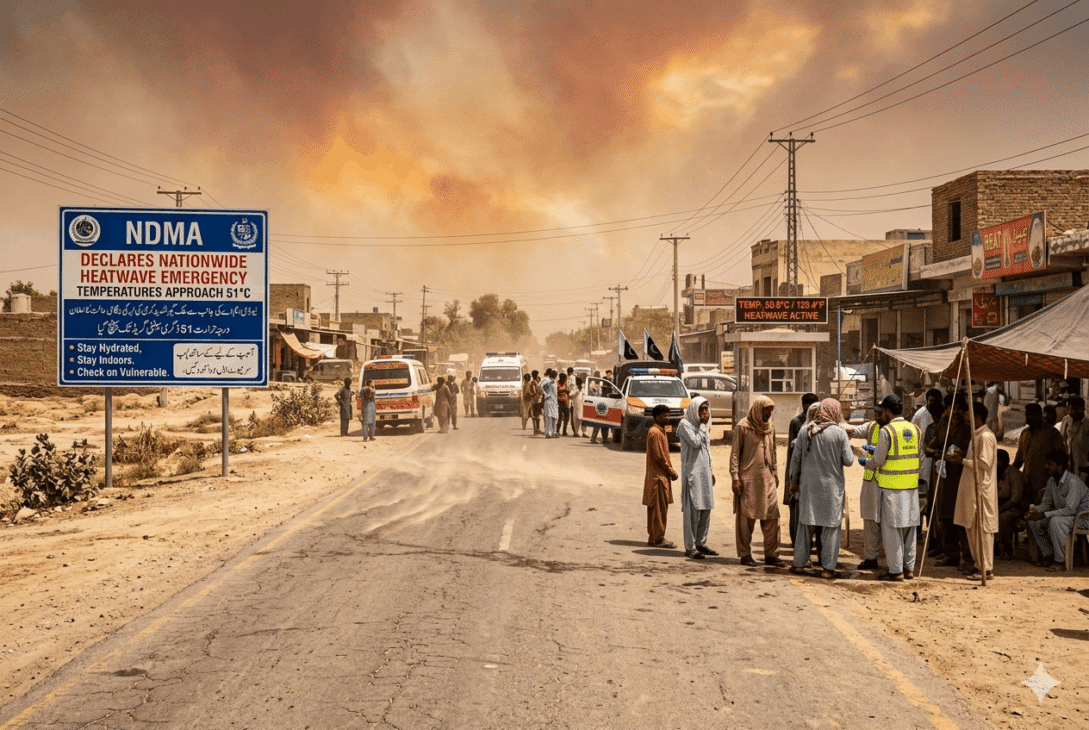
ISLAMABAD — Pakistan woke up today to an official nationwide emergency. The National Disaster Management Authority, in a high-level alert issued this morning, warned that large parts of the country will remain under severe and dangerous heatwave conditions from today, May 19, until at least May 26 — seven consecutive days of extreme heat that meteorologists say represent one of the most sustained and geographically widespread thermal events Pakistan has experienced in modern recorded history.
The NDMA warning covers exceptionally high temperatures expected to persist for three to five consecutive days in several districts of Punjab, Sindh and Balochistan. In Punjab, the districts named in the alert include Bahawalpur, Rahim Yar Khan, Bahawalnagar, Multan, Dera Ghazi Khan, Muzaffargarh, Rajanpur, Sargodha, Lodhran, Khanewal, Vehari and Lahore. In Sindh, severe heat conditions are expected in Hyderabad, Jacobabad, Khairpur, Sukkur, Larkana, Dadu, Naushahro Feroze, Kashmore, Tharparkar, Shaheed Benazirabad, Matiari, Mirpurkhas, Umerkot, Badin, Qambar Shahdadkot and Karachi, as well as nearby areas.
That is not a warning. That is a geography lesson in suffering.
“Hot and dry weather is expected in most regions, with extremely high temperatures in the plains. Citizens must avoid exposure to direct sunlight during peak afternoon hours and remain hydrated at all times.” — Pakistan Meteorological Department, May 19, 2026
The Numbers That Should Frighten Every Pakistani
Major urban centres, including Lahore, Faisalabad, Multan, Attock, and Sahiwal, are facing extreme heat, with forecasts predicting temperatures between 45°C and 47°C. Multan recorded 46°C with 56 percent relative humidity, Dera Ghazi Khan 46°C with 42 percent humidity, Sargodha 47°C with 52 percent, and Lahore 46°C with 36 percent, indicating dangerous heat index levels across all major Punjab cities.
In Sindh, the numbers are even more alarming. Dadu district is expected to peak between 47 and 51°C over the next three days, while Nawabshah, Mithi and Mohenjo-Daro will likely hover between 42 and 48°C. Karachi, with higher humidity, is forecast to reach up to 40°C recorded temperature, but the combination of heat and moisture pushes the feels-like reading considerably higher.
Karachi’s Old Airport weather station previously recorded a maximum temperature of 40.9°C alongside 52 percent humidity, conditions that pushed the heat index four to five degrees above the recorded temperature — bringing the feels-like reading close to 45°C and creating severe discomfort for residents across the city. In some western Karachi neighbourhoods, that number has already crossed 50°C in the afternoon hours.
Deaths Are Already Being Counted
In Pakistan, at least 10 people were reported to have died from heat-related complications in a single day, according to local emergency services, as extreme heat gripped Karachi and surrounding cities. In Karachi, temperatures reached 44°C — the highest recorded there since 2018 according to the Pakistan Meteorological Department. Sindh cities of Jacobabad and Sukkur are expected to see temperatures as high as 46°C in the coming days.
These are the official numbers. Experts warn the real toll is almost certainly higher. Islamabad-based climate expert Fahad Saeed has raised concerns about Pakistan’s preparedness and transparency, pointing to historical discrepancies between official figures and on-the-ground reality. He stressed that acknowledging the true scale of loss and damage is critical — not only to mobilise public awareness but to access international climate funds and develop effective emergency response systems.
The Eid al-Adha Timing Is a Crisis Within a Crisis
Pakistan’s most physically demanding religious observance — Eid ul Azha, confirmed for Wednesday, May 27 — falls directly inside this heatwave window. Millions of Pakistanis will be outdoors, handling sacrificial animals, performing slaughter, and processing meat in open-air conditions during what may be the hottest week of the year. Health authorities are specifically urging families to conduct their Eid sacrifices in the early morning hours, before peak heat arrives, and to ensure that elderly family members, children, and those with cardiovascular conditions remain indoors during afternoon hours.
Animal traders are also reporting serious difficulties. Livestock transportation from rural supply areas to urban markets has become dangerous for the animals themselves in this heat, and multiple reports have emerged of cattle and goats suffering heat stress during transit — a factor that is pushing already elevated sacrificial animal prices even higher as supply chains strain under the weather conditions.
What Authorities Are Doing — And What They Are Not
Relief Commissioner Punjab Nabeel Javed and PDMA Director General Irfan Ali Kathia have issued directives to all Commissioners and Deputy Commissioners to remain on high alert, with instructions to ensure the availability of cold drinking water at public places, bus terminals and marketplaces, and to prioritise water supply in the drought-prone Cholistan region. Heatwave response counters have been established at all major hospitals, and arrangements have been made to ensure the availability of essential medicines.
What authorities are not doing — or not doing sufficiently — is addressing the electricity load-shedding crisis that accompanies every major heatwave in Pakistan. In cities already on the NDMA’s danger list, power outages lasting eight to fourteen hours are stripping working-class neighbourhoods of their only protection against lethal heat: fans and air coolers. A family in Multan with no electricity during a 47°C afternoon is not experiencing discomfort. They are in danger.
The Climate Context Nobody Wants to Acknowledge
A record-breaking, deadly heatwave sweeping South Asia has pushed temperatures to dangerous highs, disrupting daily life for hundreds of millions and raising new concerns about the vulnerability of one of the world’s most densely populated regions. Countries including India, Pakistan and Bangladesh have seen temperatures soar well above seasonal averages, with some areas approaching or exceeding 45 to 50 degrees Celsius.
The United Nations has warned that the El Niño weather phenomenon is expected to return in mid-2026, with its weather and climate agency indicating that El Niño conditions could develop as early as May to July — a development that would further intensify an already dangerous regional heat pattern.
Pakistan contributes less than one percent of global carbon emissions. It suffers a disproportionate share of global climate consequences. The heatwave of May 2026 is not a weather event. It is a climate injustice — and Pakistanis, from the streets of Karachi to the fields of Bahawalpur to the fishing villages of Sindh’s coast, are paying a price they did not earn.
SAFETY ADVISORY — Share This With Your Family:
- Avoid all outdoor activity between 11am and 5pm
- Drink at least 3–4 litres of water daily even if not thirsty
- Wear loose, light-coloured cotton clothing outdoors
- Watch for heatstroke signs: confusion, no sweating despite heat, rapid pulse — call emergency services immediately
- Conduct Eid sacrifices before 8am this year
- Check on elderly neighbours, labourers, and street vendors in your area