
By Rehana Siddiqui, Legal & Foreign Affairs Correspondent | WATER SECURITY | May 19, 2026
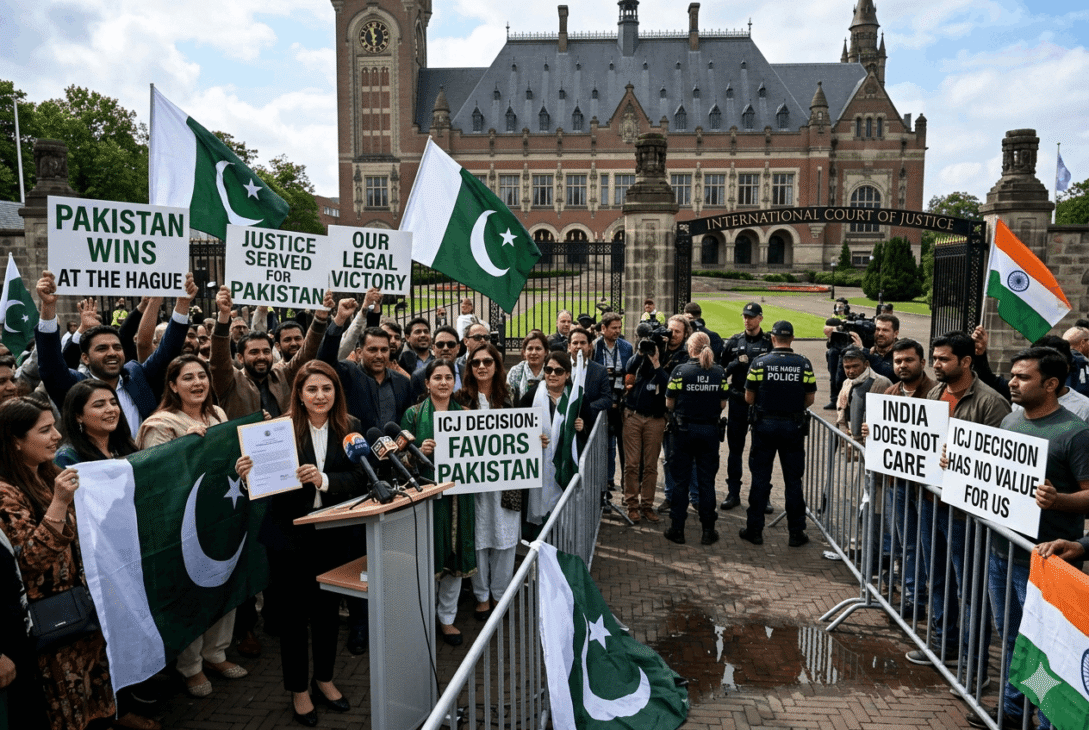
ISLAMABAD — It was a legal victory sixty years in the making. On May 15, 2026, the Permanent Court of Arbitration at The Hague issued a Supplemental Award in the long-running dispute between Pakistan and India over the Indus Waters Treaty — and it upheld Pakistan’s position on every significant point. India’s response, delivered within hours by its Ministry of External Affairs, was a masterclass in international petulance: it called the court “illegally constituted” and said it did not recognise its authority, its proceedings, or its rulings.
Pakistan celebrated. India dismissed. The world’s international legal community took notice — and not in India’s favour.
“The ruling confirms Pakistan’s fundamental position that the treaty imposes clear and real limits on India’s ability to control water on the western rivers. These limits are not merely formal but apply at the planning and design stage.” — Government of Pakistan statement, May 17, 2026
What the Court Actually Ruled
The government of Pakistan expressed full satisfaction with the supplementary decision issued on May 15 by the arbitration court regarding the “maximum pondage” issue in the ongoing proceedings under the Indus Waters Treaty, related to disputes over the design of the Ratle Hydroelectric Plant and the Kishanganga Hydroelectric Project. The statement confirmed that the ruling upholds Pakistan’s position that the treaty imposes clear and real limits on India’s ability to control water on the western rivers — limits that apply at the planning and design stage and cannot be fulfilled later through operational assurances alone.
In plain language: India has been building large hydropower reservoirs on rivers that the 1960 Indus Waters Treaty — mediated by the World Bank and binding on both nations — allocated for Pakistan’s “unrestricted use.” The Ratle project on the Chenab and the Kishanganga project on the Neelum-Jhelum system are the two most contested. The Hague-based PCA has ruled that specified exceptions for the generation of hydroelectric power must conform strictly to the requirements laid down in the Indus Waters Treaty, rather than to what India might consider an “ideal” or “best practices” approach.
This matters enormously. India’s position had been that it could design its hydropower projects in accordance with its own engineering standards and notify Pakistan afterward. The court has said no: the treaty’s requirements are binding from the design stage. India cannot build first and justify later.
Why India’s Rejection Carries No Legal Weight
India’s Foreign Office does not recognise the tribunal’s authority, proceedings, or rulings, and insists that its unilateral decision to suspend the treaty remains fully in force. However, international legal analysts argue that India’s stance lacks validity under international law, noting that the Court of Arbitration was established directly under the Indus Waters Treaty itself — a binding international agreement signed by both nations.
Former ambassador Manzoorul Haq, criticising the Indian government spokesperson’s rejection of the international court’s authority, said it reflected what he described as the “fascist mindset” of the Modi administration and its disregard for global legal institutions. He noted that India had already acted in disregard of UN Security Council resolutions on Kashmir and was now ignoring the arbitration court’s ruling on the Indus Waters Treaty, exposing New Delhi’s indifference to international commitments and institutions.
The legal reality is straightforward: you cannot sign a treaty, benefit from its provisions for sixty years, and then declare the enforcement mechanism “illegally constituted” when it rules against you. India’s position has no foundation in international law. It does, however, have a foundation in raw political power — and that is precisely what makes it dangerous.
The Chenab Flow Crisis: Evidence of Manipulation
Beyond the legal battle, a physical crisis is already unfolding. Pakistan’s Indus Waters Commissioner formally wrote to his Indian counterpart seeking clarification over reported reductions in Chenab River flows under the treaty framework. Former chairman of the Political Science Department at the University of Peshawar, Prof Dr AH Hilali, accused India of undermining the treaty through controversial hydropower projects such as Kishenganga and Ratle, calling them a dangerous precedent. He said a sharp decrease in Chenab River flow from April 30 to May 21 pointed to unilateral manipulation of river flows by India without prior notification or information-sharing, as required under the treaty.
These reductions in Chenab flows are arriving at the worst possible moment — as Pakistan enters its critical kharif crop planting season and as the country faces an extreme heatwave that is already stressing agricultural water availability. If India is deliberately manipulating Chenab flows during this period, the consequences for Pakistan’s food security will be felt not in diplomatic corridors but in fields across Punjab and Sindh.
What Pakistan Must Do Next
Pakistan’s legal victory at The Hague is meaningful but not self-executing. India has made clear it will not comply voluntarily. Pakistan’s options going forward include escalating to the World Bank — which technically guarantees the treaty — and internationalising the dispute through the UN Security Council and General Assembly, where India’s brazen rejection of binding arbitration will be difficult to defend even among New Delhi’s allies.
The Indus Waters Treaty, mediated by the World Bank in 1960, is one of the most successful international water agreements in history. It survived three wars between Pakistan and India. It cannot survive one country deciding its courts do not exist. If India succeeds in making that position stick, the consequences extend far beyond Pakistan — because every water-sharing agreement in the world rests on the same principle that international rulings are binding. India, in rejecting The Hague’s authority, is not just threatening Pakistan’s rivers. It is threatening the entire architecture of international water law.