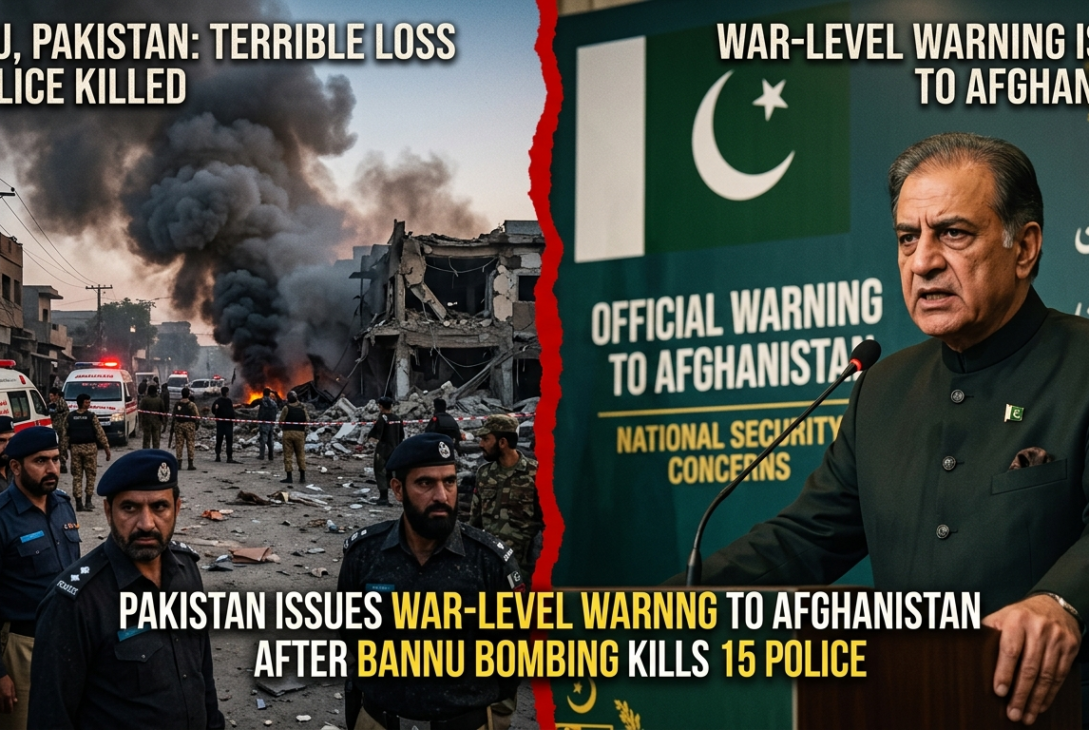
ISLAMABAD — Three days after a suicide car bomb tore through a police checkpoint in Khyber Pakhtunkhwa’s Bannu district and killed fifteen officers, Pakistan on Monday issued its starkest warning to the Afghan Taliban in years — summoning Kabul’s envoy to the Foreign Ministry and making clear that Islamabad was prepared to act militarily if the killing did not stop.
The attack, which struck the Fateh Khel Police Post late on Saturday night, was no ordinary militant strike. According to senior security officials, the assault began when a vehicle packed with explosives was driven directly into the compound at high speed, detonating on impact and flattening the checkpoint. Moments later, heavily armed fighters swarmed from multiple directions, opening sustained gunfire. Quadcopters and drones — a disturbing new addition to the militant arsenal — were used to coordinate the assault in real time. When dawn broke, fifteen police constables were dead and four more wounded, including a civilian.
“The attack was masterminded by terrorists residing in Afghanistan. Pakistan reserves the right to respond decisively against the perpetrators of this barbaric act.” — Pakistan Foreign Office Statement, May 12, 2026
How Pakistan Became the Unlikely Mediator
In diplomatic language, a ‘demarche’ is a formal protest — a signal of serious displeasure between states. Pakistan’s demarche today was something considerably more pointed. The Foreign Ministry statement, issued after Afghan Chargé d’Affaires Sardar Ahmed Khan Shakeeb was called in, combined the language of accusation with an explicit threat. Pakistan said its investigation — backed by what it called ‘technical intelligence and collected evidence’ — had determined that the attack was planned inside Afghanistan.
The Foreign Office named Fitna al-Khawarij — the government’s preferred designation for the banned Tehreek-e-Taliban Pakistan (TTP) — as the group responsible. It also pointed to UN Monitoring Team reports that have documented the continued presence of multiple militant organisations operating freely on Afghan soil. The message to Kabul was unambiguous: meaningful action or face consequences.
KEY FACTS
- Date of attack: Saturday, May 9, 2026 — late night
- Location: Fateh Khel Police Post, Bannu District, Khyber Pakhtunkhwa
- Casualties: 15 police constables martyred, 4 injured (including 1 civilian)
- Method: VBIED suicide bomb + coordinated gunfire + drones/quadcopters
- Claim: Ittehad-ul-Mujahideen Pakistan (TTP-aligned alliance)
A Pattern of Escalation
The Bannu attack is the deadliest assault on security personnel in recent months but sits within a deeply disturbing pattern. Since Pakistan launched military operations inside Afghanistan in February, targeting what it described as militant strongholds, the TTP and allied groups have intensified their campaign of retaliatory strikes inside KPK. The February operations temporarily disrupted some militant command structures but appear to have accelerated recruitment and hardened attitudes on both sides of the Durand Line.
Pakistan has engaged the Afghan Taliban in multiple rounds of talks, mediated by Saudi Arabia, Turkey, and Qatar. Each round has ended with commitments that the Taliban subsequently failed to honour. Islamabad’s patience, officials say, has now run out. Defence analysts note that the language of today’s demarche — particularly the phrase ‘respond decisively’ — is precisely the phrasing Pakistan used before its February operations.
The Domestic Political Dimension
Inside Pakistan, the attack has landed with particular force because it follows weeks of elevated public anxiety about the security situation. KPK residents in border districts have grown accustomed to living with the threat of militant violence, but the sophistication of Saturday’s operation — the drone coordination, the simultaneous breaches from multiple directions — signals a leap in capability that has alarmed military planners. Opposition parties, including PTI, have seized on the attack to demand greater government accountability on the security file, while the government has been careful to direct public anger outward, toward Kabul.
“If the Afghan Taliban regime continues to harbour these terrorist organisations, Pakistan will not compromise on its national security or on the safety and protection of its citizens.” — Ministry of Foreign Affairs, Government of Pakistan
What Happens Next
Pakistan has three options on the table, according to sources familiar with internal security deliberations. The first is continued diplomatic pressure, including multilateral engagement through China — which maintains relations with both Islamabad and the Afghan Taliban — to broker a binding counter-terrorism commitment. The second is targeted cross-border strikes of the kind Pakistan conducted in February, which carry the risk of further Taliban retaliation. The third is a comprehensive reassessment of Pakistan’s Afghanistan policy, potentially including border closures and economic pressure on a regime that depends on Pakistani trade routes.
None of these options is clean. Each carries costs. But senior officials made clear Monday that the status quo — in which Pakistani security personnel are killed by militants operating from Afghan soil with apparent impunity — is no longer acceptable to Islamabad. The next seventy-two hours will determine whether Kabul blinks.