ISLAMABAD — On the night of May 6–7 last year, Pakistan went to sleep in a state of uneasy normalcy and woke to a country at war. Indian missiles were falling on Pakistani soil — on Bahawalpur, on Muridke, on sites in Azad Kashmir — and within hours the Pakistan Air Force had scrambled fighters and launched retaliatory strikes. Four days later it was over, ended by a ceasefire brokered under intense American pressure. A year on, both sides are claiming victory and neither is entirely wrong.
Pakistan this week is marking the anniversary with the full weight of state ceremony. The Pakistan Air Force held a formal commemoration at Nur Khan Auditorium in Rawalpindi, honouring pilots for what the PAF called the ‘achievement’ of downing Indian jets. The Punjab Assembly convened a special session and unanimously adopted a resolution praising the armed forces. In Lahore’s Liberty Chowk, a government-organised concert drew large crowds on Friday evening — the country’s war rebranded, officially, as ‘Youm-e-Bunyanum Marsoos’: the Day of the Battle of Truth.
“The myth of India’s conventional military dominance has been broken.” — Dawn Editorial, May 10, 2026
What Pakistan Gained
Pakistan’s most significant gain from the four-day conflict has been diplomatic, not military. Islamabad’s repeated crediting of US President Trump for mediating the ceasefire — including its nomination of Trump for the Nobel Peace Prize — earned it considerable goodwill in Washington at a moment when India’s refusal to credit Trump had cooled New Delhi’s relationship with the White House.
The consequence has been a remarkable elevation of Pakistan’s strategic standing. Army Chief Field Marshal Asim Munir was received by Trump for a private White House lunch in June — the first time a US president had privately hosted a Pakistani military chief without civilian leadership present. By April 2026, Munir had travelled to Tehran as the first regional military leader to do so since the US and Israel launched war on Iran, playing a central role in the April 8 ceasefire between Washington and Tehran. Pakistan, which a year ago appeared diplomatically isolated, is now being described by commentators as ‘a deft handler of global power politics.’
ONE YEAR ON: SCORECARD
- Pakistan’s global profile: Dramatically elevated — key US-Iran mediator
- India–Pakistan diplomatic ties: Frozen — deep mistrust persists on both sides
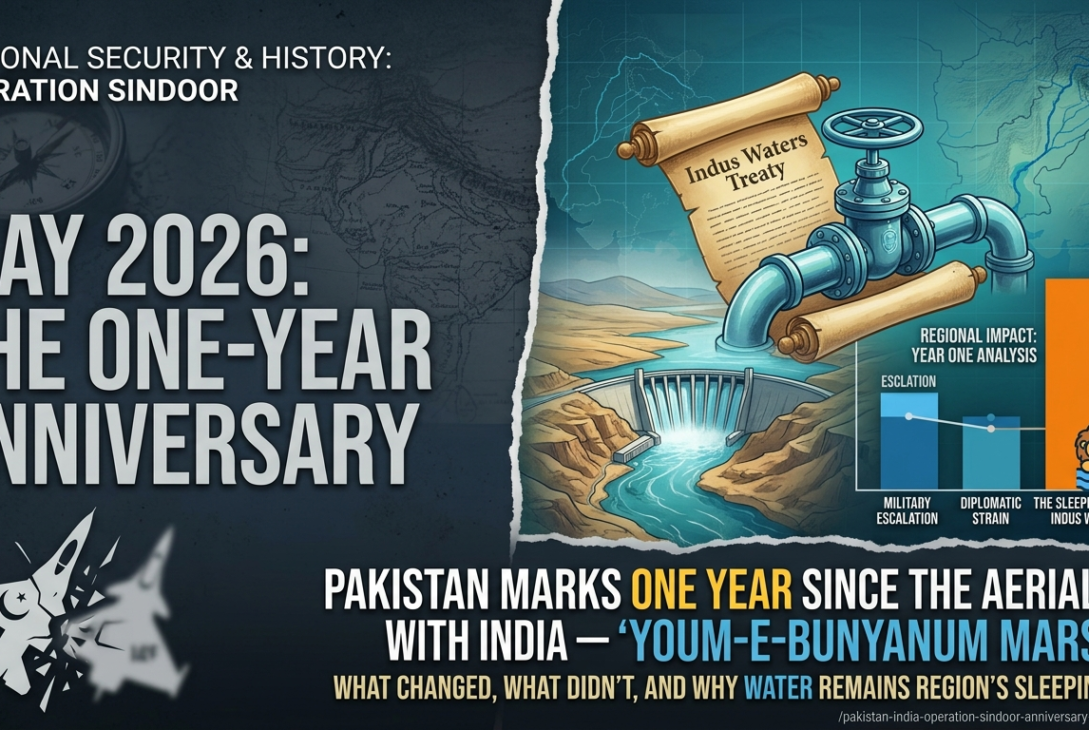
- Indus Waters Treaty: Suspended by India since April 23, 2025 — not restored
- PAF capability gap: HQ-19 missile defence system in procurement pipeline
- Pakistan’s water risk: Only ~30 days of storage vs India’s 120–220 days
The Water Crisis Nobody Is Talking About
Beneath the patriotic celebrations lies a crisis that no amount of diplomatic success can resolve: water. India suspended the Indus Waters Treaty on April 23 last year — two weeks before Operation Sindoor — and has shown no sign of reinstating it. The treaty underpins one of the world’s largest contiguous irrigation systems, supplying more than 80 percent of Pakistan’s agricultural water and sustaining the livelihoods of more than 240 million people.
Pakistan’s effective water storage capacity stands at roughly 30 days. India’s sits between 120 and 220 days. The asymmetry is existential. Federal Planning Minister Ahsan Iqbal told a government meeting on water security last month that India’s use of water as an instrument of pressure represented ‘a serious external dimension to Pakistan’s water security’ — careful language for a genuinely alarming situation. Cotton inventories have dropped to critically low levels ahead of the new crop season.
What the Military Learned
Pakistan’s official narrative of the conflict — that the PAF performed ‘genuinely remarkably’ in the opening hours — is supported by independent analysts, who note that Pakistan’s air defence coordination in the conflict’s first phase displayed both technical competence and escalation discipline. The PAF’s claimed downing of Indian aircraft, including reportedly a Rafale jet, sent shockwaves through Western defence circles about the relative effectiveness of Chinese and Western military hardware.
But analysts are equally clear about what the later stages of the conflict exposed. Pakistani airbases suffered significant damage from Indian BrahMos strikes, revealing gaps in ground-based air defences. Pakistan is now procuring the longer-range HQ-19 ballistic missile defence system, with induction anticipated later in 2026.
“Pakistan will have to meet this challenge through hardened shelters, dispersals, and urgent runway repair capacities to avoid being incapacitated in the next conflict.” — Faisal, Defence Analyst, Sydney
India’s Anniversary Messaging — and What It Signals
India has marked the anniversary with its own confident messaging. Lieutenant General Rajiv Ghai told a press conference in Jaipur that ‘Operation Sindoor was not an end — it was just the beginning.’ India’s Ministry of External Affairs said New Delhi retained ‘every right to defend itself against cross-border terrorism.’ A year after Sindoor, the most honest assessment is this: neither country won decisively. Pakistan avoided military defeat, gained diplomatic capital, and enhanced its global standing. India demonstrated unprecedented strike capability but failed to shift Pakistan’s strategic calculus. The region’s two nuclear-armed adversaries are, by some measures, more dangerous to each other than they were twelve months ago.