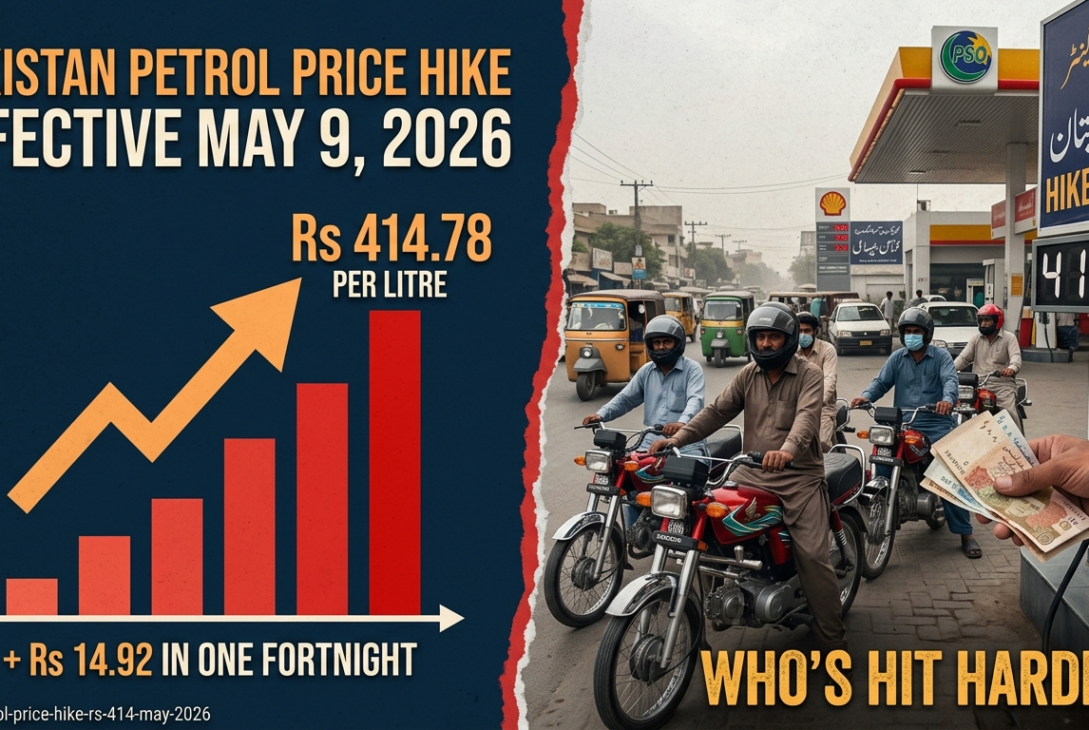
ISLAMABAD — The fortnightly envelope from the Petroleum Division has become something Pakistanis open with dread. This week it delivered another blow: petrol prices effective May 9 stand at Rs414.78 per litre, a rise of Rs14.92 in a single fortnight. Diesel — the fuel on which Pakistan’s trucks, buses, and agricultural pumps run — has climbed to Rs414.58 per litre, up Rs15. The numbers matter not just to motorists but to every Pakistani who eats food that was transported, wears clothes that were manufactured, or takes any form of public transport.
ARY News led its midnight bulletin on Monday with ‘Big News Regarding Petrol Price Hike’ — a headline that, in Pakistan, needs no further explanation. For a country where petrol at Rs414 per litre represents a staggering multiple of monthly incomes for millions of working-class families, each fortnightly revision has come to feel like a recurring personal financial crisis.
“The government is collecting Rs117.5 per litre in petroleum levy — far exceeding the IMF-agreed limit of Rs80. Ordinary citizens are being asked to pay for the state’s fiscal failures.” — Ali Zafar, PTI Spokesperson, May 11, 2026
Why Prices Are So High — And Rising
The explanation operates on two levels. The immediate cause is international: the ongoing US–Iran conflict has severely disrupted oil shipping through the Strait of Hormuz, through which approximately a fifth of the world’s traded oil passes. Pakistan, which imports virtually all of its petroleum products, has seen its fuel import bill explode from $300 million to $800 million in a matter of months — a 167 percent increase that has torn through the current account like a wrecking ball.
But the structural causes run deeper and predate the Middle East crisis. Pakistan’s rupee has lost catastrophic value against the dollar over the past three years, meaning import costs in rupee terms are punishing even when dollar prices are moderate. The government’s practice of maintaining artificially low fuel prices through subsidies ended under IMF pressure, leaving consumers exposed to the full force of global price movements.
FUEL PRICE TRACKER
- Petrol (MS-92) — May 9, 2026: Rs 414.78 per litre (▲ Rs 14.92)
- High-Speed Diesel — May 9, 2026: Rs 414.58 per litre (▲ Rs 15.00)
- Petrol — May 1, 2026: Rs 399.86 per litre
- All-time highest: Rs 458.40 per litre — April 3, 2026
- Pakistan fuel import bill: Jumped from $300m to $800m since Gulf crisis began
The IMF Equation
PTI’s Ali Zafar has placed a sharp political frame around the crisis, alleging that the government is collecting Rs117.5 per litre in petroleum levy — nearly fifty percent above the Rs80 per litre cap agreed with the International Monetary Fund. If accurate, the allegation would represent a significant breach of Pakistan’s IMF conditionalities. The government has not directly addressed the figures, instead pointing to the global price environment as the primary driver of consumer pain.
Finance Minister Muhammad Aurangzeb has separately indicated a desire to lower income tax rates and raise the taxable income threshold for salaried workers — a signal that the government understands the cost-of-living crisis is reaching politically dangerous levels.
A National Fuel Pass — Relief on the Horizon?
Officials have floated a ‘National Fuel Pass’ scheme — a digital subsidy mechanism that would provide targeted relief to low-income commuters and small vehicle owners through vouchers and fuel quotas. The concept is designed to allow the government to remove blanket subsidies, which primarily benefit middle-class car owners, while protecting the most vulnerable.
Transport operators in Punjab and Sindh say they have no choice but to pass costs on to passengers. Ride-hailing fares in Islamabad have risen 35 percent since March. Fuel prices and food prices — Pakistan’s two most politically combustible variables — are now both moving in the wrong direction at the same time. The government is watching nervously.